
Talios I
Overview
Section titled “Overview”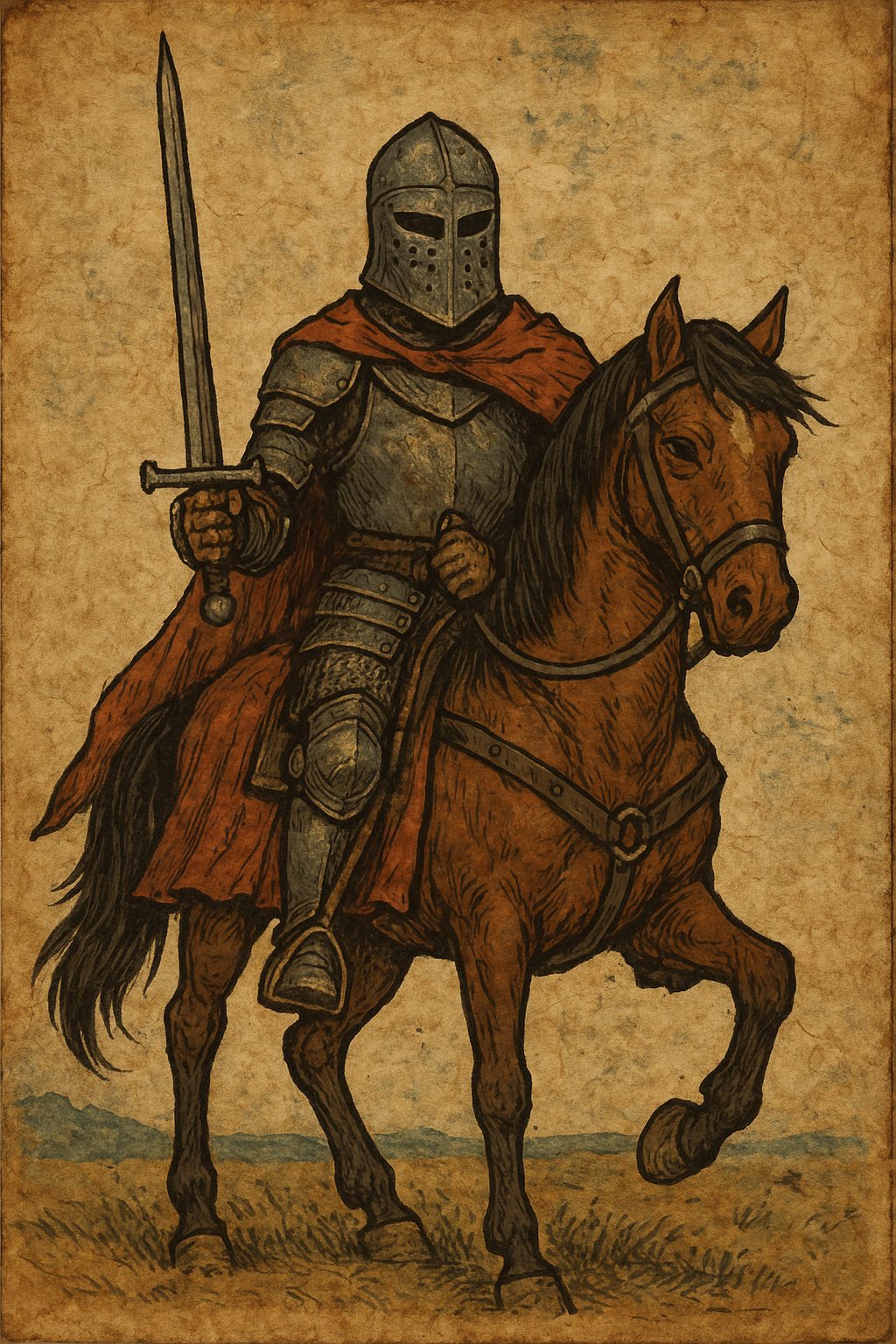 (Emperor Talios I riding his horse, Art by:Telmin Valazar, 62 A.H)
| Category | Information |
|---|---|
| Full Name | Talios Aquabrand I |
| Aliases / Titles | The Iron Reformer, Builder-King, Second Crown of Erule |
| Race / Subrace | Erulian (Human) |
| Gender | Male |
| Date of Birth | 12 A.H. |
| Place of Birth | Rose Palace, Erule, Droskarin |
| Age | 66 at death |
| Status | Deceased |
| Affiliation(s) | Erulian Empire, House Aquabrand, Hexadem |
| Occupation / Role | Second King of Erule / First Emperor of the Erulian Empire |
| Language(s) | Erulian (native), Common |
| Religion / Baptism God | Tiamat |
| Family / Lineage | Son of Calados I; father of Talios II |
| Physical Description | Broad-shouldered; strong military posture; golden-tanned skin; dark brown hair with streaks of grey later in life; deep-set blue eyes. Often depicted wearing a red ceremonial cloak and his father’s rose-forged armor. |
| Personality Traits | Assertive, disciplined, strategic, prideful, ambitious, fiercely loyal to the Hexadem, occasionally ruthless. |
| Skills & Abilities | Military leadership, siege tactics, diplomacy through strength, state organization, early naval development. Skilled battlefield combatant with sword and spear. |
| Magic Affinity | Minor battle-blessing attunement from Tiamat; no formal magical training. |
| Allies | The Hexadem clergy; Erulian nobility; early military generals |
| Rivals / Enemies | Orc tribes, Permateshian elves, Bolborkians, rebellious clerics |
| Important Relationships | Spouse: Queen Averia Lenthros Heir: Talios II |
| Artifacts / Equipment | The Spear of Tiamat (ceremonial), Imperial Redblade (personal sword), reinforced rose-metal armor inherited from Calados I |
| Quotes | “Strength is the language all realms understand.” |
| Legacy | Remembered as the emperor who transformed Erule from a spiritual kingdom into a conquering imperial force. He set the stage for centuries of Erulian expansion. Revered by some for his order and stability, criticized by others for setting moral precedents that enabled later tyranny. |
| Year of Death | 78 A.H. |
| Cause of Death | Arrow wound during a Bolborkian uprising |
| Burial Site / Memorial | Buried in the Grand Cathedral of the Hexadem, beside Calados I |
| Emperor Talios I Aquabrand, the only son of King Calados I, stands as one of the most formative figures in the early history of the Erulian Empire. Where his father laid the spiritual and administrative foundations of Erule, Talios I transformed that foundation into the beginnings of an imperial power. Crowned in 40 A.H. at the age of 28, he inherited a kingdom rich in faith, unity, and cultural identity but limited in influence. Through discipline, military innovation, and a fierce devotion to the Hexadem, Talios I reshaped Erule into a nation capable of expansion. |
Talios I is remembered primarily as the ruler who transitioned Erule into the Erulian Empire. His leadership marked the beginning of the Expansion Era, defined by his calculated campaigns into the Permateshian Forest and the orcish regions of the Southern Desert. Unlike his father—whose leadership was driven by spiritual vision and moral unity—Talios prioritized strength, structure, and tactical dominance. Under his command, Erule developed its first formal military hierarchy, standardized weaponry, and constructed fortified roads that enabled rapid troop movement across Droskarin.
Spiritually, Talios remained deeply committed to the Hexadem, especially Tiamat, whose values of bravery, conflict, and honor shaped his philosophy of rule. He viewed military conquest not merely as territorial gain but as a divine mandate—believing that bringing more people under Erulian order was a form of spiritual guidance. This conviction earned him immense loyalty among Hexademic clerics and soldiers alike.
Talios’s reign, however, was not without controversy. His policies were markedly harsher than those of Calados, and his tolerance for rebellion was minimal. He legalized torture, instituted public displays of punishment, and enacted severe measures against conquered populations, especially orcish and elven groups. These decisions later enabled the brutality of his son’s reign and remain debated among historians.
Despite his severity, Talios I is regarded as a disciplined, focused, and fundamentally stable ruler, one who believed that a strong empire required unwavering resolve. His death in 78 A.H., caused by an arrow during a Bolborkian uprising, brought an abrupt end to a reign that had forever altered the course of Omain’s political landscape.
To this day, Talios I is remembered as a builder of empires—a leader whose tactical mind and relentless ambition shaped the Erulian Empire’s destiny for centuries to come. He stands as the bridge between Calados’s peaceful unification and the martial era that dominated the Empire’s next generations.
Appearance
Section titled “Appearance”Emperor Talios I Aquabrand carried the commanding presence of a seasoned warrior-king—broad-shouldered, disciplined in posture, and almost unnervingly composed. Standing slightly taller than the average Erulian male, he possessed a sturdy build forged through years of military training and campaign riding. His features, inherited in part from the Aquabrand line, were sharp and angular: high cheekbones, a strong jaw, and stern dark eyes that were said to assess a room before he ever spoke.
However, very few citizens of the empire ever saw his face clearly.
Talios I was known for appearing in public almost exclusively wearing his masked helmet, a distinctive piece of Erulian craftsmanship that became an icon of his reign. Forged of dark steel and shaped in the visage of a serene but unreadable warrior’s expression, the helmet concealed the entirety of his face except for his eyes, which glinted through narrow slits. The mask was adorned with understated engravings representing Tiamat and the early Hexademic motifs of bravery and conflict. Many believed he wore it as a symbol of divine authority; others whispered it was a deliberate tactic to appear less human and more imperial—an embodiment of the Empire itself.
When without armor, which was rare outside private or clerical settings, Talios dressed in layered robes of deep red and silver, the imperial colors of early Erule. Witnesses claimed he carried himself with a quiet and intense confidence, moving with the precision of a soldier even in ceremonial garments. His hair, when visible, was a dark chestnut, kept short at the sides for practicality, and his beard—a well-maintained but short trim—matched in color.
Old journals from palace servants mention that without the mask he looked far younger and gentler than people assumed, with a tiredness around the eyes that revealed the weight he carried. But such glimpses were rare; to the world, Talios I was the Faceless Emperor, a symbol of power carved in steel.
Personality
Section titled “Personality”Emperor Talios I was, above all else, a man of controlled intensity—disciplined, pragmatic, and often interpreted as emotionally distant. Those who served close to him described a ruler guided not by impulsive passion but by an unwavering sense of duty, order, and consequence. He was rarely seen smiling, and even in private moments his demeanour remained composed, as though he were constantly weighing the future of the empire against the frailty of individual sentiment.
Talios I believed deeply in the idea that a ruler must be both protector and weapon, and he shaped his life around this philosophy. He valued strength—not brute violence, but decisive strength: the capacity to act when others hesitated. This belief placed him at odds with softer members of the clergy but earned him immense respect among soldiers, settlers, and the early nobility. He was not cruel by nature, but he held a firm conviction that mercy without caution was weakness, a trait shaped by the chaotic tribal conflicts of his youth.
Publicly, Talios I cultivated an aura of stoic mystery, only amplified by his constant use of the masked helmet. Citizens believed he was unshakable, an emblem of Erule’s stability. In truth, his closest advisors recount that he was a deeply reflective man—quiet, observant, and prone to moments of private melancholy. He carried a fear that the work of his father, Calados I, could be undone by indecisiveness, and this drove him to act swiftly in matters of state.
Talios I had a strong moral compass firmly aligned with Hexademic teachings, especially those of Tiamat, whose values of bravery and honorable combat shaped his approach to war. Unlike his father, he did not obsess over the gods, but he viewed his role as emperor as a sacred stewardship, a responsibility inherited from divine will. He prayed regularly, but never publicly—religion was to him a source of guidance, not a political performance.
Despite his stern exterior, there was a surprising gentleness in his private relationships. He was fiercely loyal to those he trusted and believed deeply in the potential of the empire as a force for order and enlightenment. However, he struggled with emotional vulnerability; grief, fear, and affection were rarely expressed outwardly, leading many to believe him colder than he truly was.
Talios I was not a visionary dreamer like Calados I, nor a tyrant like his son Talios II. He was a builder, a stabiliser, and a man determined to secure the empire’s foundations. His personality forged the Erulian Empire into a disciplined, unified force—and those who followed him would inherit not only his throne, but the weight of his unwavering expectations.
Influence & Resources
Section titled “Influence & Resources”As the second ruler of the Erulian Empire, Talios I Aquabrand commanded an extraordinary range of power and authority—far greater than his father had during the early days of nation-building. His reign marked the transition of Erule from a structured kingdom into a fully realised expansionist empire, and the resources he controlled reflected this evolution.
Political Authority
Section titled “Political Authority”Talios I wielded absolute imperial authority, inherited through the Aquabrand bloodline and sanctified by the Hexadem. His legitimacy was unquestioned; he was seen as the divine continuation of Calados I’s legacy. This granted him:
-
Total legislative control
-
The ability to appoint and dismiss nobles
-
Authority to command national projects and reforms
-
Direct influence over the clergy (though he rarely abused it)
Within Erule, his word was law.
Military Command
Section titled “Military Command”Talios I inherited a modest but highly disciplined military—small compared to later imperial forces but exceptionally loyal. He personally oversaw its expansion and modernisation. His military resources included:
-
8,000–10,000 trained infantry
-
1,000 cavalry
-
A small naval force used mainly for coastal patrol
-
Elite guards known informally as the “Red Mantles”, who served as his personal retinue
Talios I was revered by his soldiers; he often trained with them, marched with them, and wore the same armor in battle—especially his iconic masked helmet.
Economic Resources
Section titled “Economic Resources”Under his rule, Erule enjoyed its first era of true prosperity. He had direct control over:
-
Growing tax revenues from newly established settlements
-
Early trade with tribes of northern and eastern Droskarin
-
State-run granaries and irrigation projects
-
The Rose Palace treasury, filled with early imperial wealth
-
Access to tribute from conquered or compliant tribes
While the empire was not yet at its peak, Talios I managed one of the most financially stable states of the era.
Clerical Influence
Section titled “Clerical Influence”Although less overtly religious than Calados I, Talios I was deeply respected by the Hexadem clergy. This granted him:
-
Access to religious advisors
-
Ability to use the clergy for diplomatic outreach
-
Influence over early pilgrimages and Hexademic law
-
Permission to carry the Mask of the First Warrior, a sacred relic lent to him by Tiamat’s devotees (and the inspiration for his iconic helmet)
His cooperation with the Hexadem strengthened the early bond between church and crown.
Magical Access
Section titled “Magical Access”Magic was not yet widespread or institutionalised, but Talios benefited from:
-
Ritual blessings from the priests of Tiamat and Auriel
-
A few early practitioners of elemental magic
-
Access to prophetic readings from Hexademic seers
-
Minor enchantments placed upon his armor and weaponry
Talios himself had no magical talent, but he respected its potential.
Intelligence & Information Networks
Section titled “Intelligence & Information Networks”Through his disciplined soldier-scouts and loyal administrators, he maintained:
-
A network of frontier scouts in northern Droskarin
-
Informants embedded in tribal groups
-
Early diplomatic messengers trained for fast relay
-
Knowledge of local geography, river routes, and natural chokepoints
This allowed him to make strategic decisions with exceptional precision.
Personal Influence
Section titled “Personal Influence”Talios I commanded immense personal respect. His masked visage, his measured voice, and his reputation for fairness made him:
-
Intimidating to his enemies
-
Relied upon by his soldiers
-
Trusted by settlers and administrators
-
Revered as a moral example within Erule
His authority was not merely institutional—it was charismatic.
Emperor Talios I carried ambitions shaped as much by his own disciplined worldview as by the heavy expectations passed down from his father. While he developed into a leader of remarkable morality and stability, his goals were shaped by a complex mixture of duty, inherited pressure, and the responsibility of guiding a young empire into its future.
Secure and Stabilise the Empire
Section titled “Secure and Stabilise the Empire”Talios I’s foremost goal was to strengthen the foundations of the Erulian Empire. Having grown up witnessing his father’s expanding kingdom, he believed that Erule could only survive through stability and order. He aimed to:
-
Protect the capital and its early settlements
-
Establish a disciplined army capable of defending the nation
-
Bring structure to taxation, trade, and public works
-
Ensure food security and controlled urban growth
To him, prosperity was the result of purposeful action, not divine chance.
Fulfil His Father’s Expectations
Section titled “Fulfil His Father’s Expectations”Perhaps the most complex force shaping Talios I’s goals was the private burden Calados I placed upon him. In his final years, Calados became consumed by the myth of Talios, the Demon of Death described in ancient Hexademic scripture. In his obsession, he gave his son a terrible, private charge:
“Become the death that protects us from ruin, the blade that ends the empire’s enemies…”
Calados believed that someone bearing the name Talios must embody the force that destroys chaos before it devours order.
Though Talios I rejected the darker, fanatical side of this request, he internalized a symbolic interpretation of it:
-
To become the empire’s protector
-
To destroy threats before they could rise
-
To embody fearlessness and decisive judgment
He did not wish to become a demon—he wished to become a shield of death against the empire’s enemies, a guardian forged in steel rather than shadow.
Preserve the Aquabrand Line
Section titled “Preserve the Aquabrand Line”Talios I saw the Aquabrand dynasty not as a privilege but as a sacred duty. One of his lifelong goals was to:
-
Strengthen the royal lineage
-
Ensure future generations inherited a stable empire
-
Honour Calados I’s legacy without repeating his failings
He wished the Aquabrands to be remembered not just as founders, but as guardians of the world’s greatest civilization.
Maintain Balance with the Hexadem
Section titled “Maintain Balance with the Hexadem”While not a zealot, Talios valued the Hexadem as moral and cultural pillars of the empire. His goal was:
-
To maintain cooperation with the clergy
-
To honour Tiamat’s values of bravery and justice
-
To prevent religious chaos or schism in the early years
He believed faith, when disciplined, could unify a people.
Expand Knowledge of Droskarin
Section titled “Expand Knowledge of Droskarin”Talios I understood the strategic importance of knowing the land he ruled. His quieter personal ambition included:
-
Mapping northern Droskarin
-
Establishing contact with distant tribes
-
Strengthening diplomatic ties when possible
-
Avoiding unnecessary wars that could destabilize the realm
Though he conquered when needed, he preferred strength with purpose.
Create an Empire Worth Inheriting
Section titled “Create an Empire Worth Inheriting”Above all else, Talios I sought to shape the empire into something worthy of history—something his father dreamed of but never fully realized. He aimed to leave behind:
-
Strong borders
-
Loyal settlements
-
A respected military
-
A thriving capital
-
A unified people
His overarching goal was continuity—to build something that would last beyond his life.
Events
Section titled “Events”Early Life & Rise to Power
Section titled “Early Life & Rise to Power”-
24 A.H – Born in the Rose Palace of Erule
Born as the first son of King Calados I and raised under immense pressure to inherit both the throne and his father’s spiritual obsessions. -
8–40 A.H – Trained in the Values of Tiamat
Raised by Hexademic tutors and battle-masters who instilled discipline, duty, and honour instead of the darker ideologies his father pursued. -
40 A.H – Crowned Emperor of Erule
Succeeded Calados I after his father’s death from pancreatic failure. Adopted the masked helmet as his symbol of authority.
Major Achievements
Section titled “Major Achievements”-
42 A.H – Restructured the Kingdom into a Military-Ready State
Implemented the first systematic army reforms and laid the groundwork for Erule’s future imperial militarism. -
43 A.H – Authorized the First Formal Imperial Military
Created an organized fighting force capable of disciplined expansion, setting the precedent for future Erulian dominance. -
44 A.H – First Contact with the Permateshian Elves
Initiated relations with the elven tribes—initially peaceful—though these would later become fraught under future rulers. -
46 A.H – Conquest of the Permateshian Forest
Oversaw the first major expansion campaign in early Erulian history, resulting in the complete domination and enslavement of the elves of Permatesh. -
55–57 A.H – Suppression of the Desert Orc Tribes
Led the empire in subduing orcish tribes in central Droskarin, expanding imperial borders and acquiring forced labour. -
58–70 A.H – Era of Consolidation and Settlement Growth
Constructed five major settlements and expanded the internal infrastructure of the empire, ensuring long-term stability.
Controversial Actions
Section titled “Controversial Actions”-
46 A.H – Enslavement of the Permateshian Elves
Although a strategic victory, the mass enslavement sparked long-term resentment and set the stage for future racial conflicts. -
55 A.H – Forced Subjugation of the Desert Orcs
Justified militarily but criticized by later scholars as excessively aggressive. -
74 A.H – Conquest and Absorption of the Bolborkian Tribe
Initially attempted diplomacy but ultimately overrided by imperial ambition, resulting in conflict and the Bolborkian enslavement cycle that would define later centuries.
Conflicts & Military Actions
Section titled “Conflicts & Military Actions”-
46 A.H – Permateshian Campaign
Achieved total conquest in record time, demonstrating strategic mastery and military discipline. -
55–57 A.H – Desert Subjugation Campaign
Crushed orcish resistance but at the cost of several hundred Erulian lives. -
71–74 A.H – Bolborkian Campaign
Attempted diplomacy, then launched a full assault when negotiations failed.
74 A.H – “The Three-Sun Clash” becomes the symbolic name of the final battle.
Personal & Religious Events
Section titled “Personal & Religious Events”-
Throughout Reign – Wore the Masked Helmet in Public
Became an iconic and feared image of the emperor; caused rumors about his true intentions and emotional state. -
Maintained Deep Respect for the Hexadem
Though not a zealot, consulted the clergy regularly and upheld Tiamat’s values of bravery, honour, and disciplined warfare. -
Privately Rejected His Father’s Dark Wish
Calados I tasked him with becoming “Talios, Demon of Death.”
Talios I reshaped this into a moral duty: protect the empire at all costs, but do not become a monster.
Failures or Unresolved Issues
Section titled “Failures or Unresolved Issues”-
Could Not Completely Integrate the Bolborkians
Their resentment persisted and became a precursor to several major rebellions in later centuries. -
Failed to Expand Beyond Droskarian
Although strategic and careful, he made little effort to explore or cross oceans—something later emperors would aggressively pursue. -
Left Behind a World Ripe for Talios II’s Tyranny
His disciplined but rigid systems allowed his son to seize power and twist the empire toward cruelty.
Final Events
Section titled “Final Events”-
78 A.H – Killed by a Bolborkian Arrow During an Uprising
Mortally wounded during a rebellion, dying within hours. His death marked the end of Erule’s early stability. -
Buried Outside the Capital
The Hexadem deemed his final years tainted by excessive militarization. Though still honoured, his burial outside central sanctified grounds reflected a complex legacy.
Secrets
Section titled “Secrets”He rejected his father’s darkest command—but feared he might someday fulfill it
Section titled “He rejected his father’s darkest command—but feared he might someday fulfill it”Calados I, in his dying obsession, commanded Talios to “become Talios the Demon of Death”—a living instrument of divine destruction.
Talios I rejected this fanaticism publicly, but privately, he feared the prophecy might cling to his bloodline. His journals contain the line:
“Let death cling to me—not to my children.”
This fear shaped many of his stricter reforms, though the public never knew why.
The masked helmet hid more than his identity
Section titled “The masked helmet hid more than his identity”The iconic helmet was not worn merely for show. Talios I secretly commissioned it to hide:
-
A deep scar across the left side of his face from a youthful training accident
-
His near-constant exhaustion from overwork
He believed that a ruler showing weakness could destabilize the still-young empire.
Only three people in his life ever saw him without the helmet.
He secretly met with rebel Bolborkian elders before the final war
Section titled “He secretly met with rebel Bolborkian elders before the final war”Prior to the Bolborkian conflict, Talios I attempted a private peace negotiation that he never recorded in official chronicles.
He spent two nights in a disguised tent outside the Bolborkian border speaking with their leaders.
He offered:
-
Partial autonomy
-
Shared governance of border settlements
-
Religious protections
It ultimately failed, and he vowed never to reveal that he had considered leniency.
He considered dissolving slavery—but feared destroying imperial structure
Section titled “He considered dissolving slavery—but feared destroying imperial structure”Talios I found his father’s enslaving practices distasteful and morally wrong.
In early drafts of state reforms (kept in private archives), he outlined:
-
The phased abolition of slavery
-
Conversion of slaves into paid labourers
-
Redistribution of land to integrate captured peoples
However, advisers convinced him that Erule’s stability depended on the forced labour systems inherited from Calados I.
Talios never spoke of these intentions again.
He questioned Tiamat’s guidance in his final years
Section titled “He questioned Tiamat’s guidance in his final years”Though loyal to the Hexadem, Talios I wrote private doubts about:
-
Whether the gods truly guided humanity
-
Whether Tiamat’s values of honorable conflict caused more suffering than salvation
-
Whether Calados I had been misled by visions
These doubts were hidden in carefully coded texts found only centuries later by archivists.
He intentionally kept the empire contained
Section titled “He intentionally kept the empire contained”Unlike later emperors, Talios I could have expanded earlier—he had the military discipline and the growing population.
But secretly, he feared:
-
Overextension
-
Spiritual corruption
-
Becoming the “world-devouring force” Calados believed in
So he quietly resisted advisers urging early expansion, hoping his successors would choose wisdom over conquest.
His last words were not recorded truthfully
Section titled “His last words were not recorded truthfully”Publicly, the Hexadem declared his last words were:
“For Erule, for the gods.”
Privately, witnesses confirm his true final whisper was:
“Do not let him become me.”
Historians debate whether “him” referred to his son, Talios II… or the mythical Demon of Death.