
Empress Erolith I of Erule
Overview
Section titled “Overview”| Category | Information |
|---|---|
| Full Name | Empress Erolith I Aquabrand |
| Aliases / Titles | The Blessed Empress, Sovereign of Erule, The Scholar-Crown, Tiamat’s Chosen |
| Race / Subrace | Erulian (Human) |
| Gender | Female |
| Date of Birth | 1478 A.H. |
| Place of Birth | Rose Palace, City of Erule, Droskarin |
| Age | 29 (as of 1507 A.H.) |
| Status | Alive |
| Affiliation(s) | Erulian Empire, Hexadem Faith, House Aquabrand, Imperial High Court |
| Occupation / Role | Absolute Empress of the Erulian Empire, Supreme Sovereign of Imperial Colonies |
| Language(s) | Erulian (native), Common, High Hexic (liturgical & scholarly) |
| Family / Lineage | House Aquabrand (unbroken imperial bloodline) • Father: Emperor Everet I (deceased) |
| Religion / Baptism God | Hexadem – Baptised under Tiamat |
| Physical Description | Young woman of refined yet commanding presence; brown hair often worn bound in imperial fashion; piercing blue eyes; typically depicted in crimson and ivory regalia or royal armor; composed, disciplined bearing. |
| Personality Traits | Authoritative, calculating, deeply devout, intellectually formidable, emotionally reserved, capable of both mercy and ruthless resolve. |
| Skills & Abilities | High governance, strategic administration, advanced education, theological scholarship, imperial lawcraft, wartime command presence. |
| Magic Affinity | None formally practiced; surrounded by theologians and arcanists; rumored heightened metaphysical sensitivity tied to Tiamat. |
| Allies | The Hexadem clergy, the Grand Hex, Imperial High Court, provincial governors, state academies, loyal legions. |
| Rivals / Enemies | Kingdom of Ka, anti-imperial factions, dissident cults, colonial separatists, remnants of Marek’s loyalists. |
| Important Relationships | Father: Emperor Everet I (slain at the Siege of Erule) • The Grand Hex • Imperial strategos and theologians. |
| Artifacts / Equipment | The Imperial Circlet of Erule, sanctified royal armor, Seal of Absolute Decree, Hexademical regalia bound to Tiamat. |
| Quotes | “Order is mercy extended across generations.” |
| Legacy (ongoing) | Remembered already as the architect of unprecedented economic growth, internal stability, and centralized imperial reform; regarded by many as a divinely-guided ruler. |
| Date of Coronation | 4th of Imperion, 1497 A.H. |
| Cause of Ascension | Death of Emperor Everet I during the Ruthless Siege of Erule led by King Marek of Ka. |
| Burial Site / Memorial | N/A (living) — Emperor Everet I rests in the Grand Imperial Sepulcher of Erule. |
Empress Erolith I is the reigning sovereign of the Erulian Empire and the absolute authority over its territories and colonial dominions. Ascending the throne ten years ago, she has already come to be regarded as one of the most formidable rulers in Erulian history—both feared and revered in equal measure.
Erolith was crowned in the aftermath of one of the darkest days in imperial memory: the Ruthless Siege of Erule, when King Marek of Ka launched a devastating assault on the capital. Wielding the power of Flame, Marek’s forces breached the inner districts and slaughtered nearly half the city’s population. Among the dead was Emperor Everet I, Erolith’s father, who fell defending the Rose Palace. The streets of Erule burned for days. The Empire nearly fractured.
Erolith, only nineteen at the time, was elevated to the throne amid smoke, mass graves, and civil panic.
Where many expected a fragile or symbolic ruler, Erolith revealed the opposite.
Hard-headed, relentlessly disciplined, and profoundly academical, she is widely regarded as a “blessed child” of the Hexadem. Imperial scholars often claim her intellect surpassed her father’s before she ever reached adulthood. Since her coronation, she has engineered an era of economic growth, administrative reform, and internal peace unmatched in the Empire’s recorded history. Trade networks were stabilized, provincial unrest was crushed without widespread bloodshed, and imperial institutions were reshaped into efficient, centralized engines of governance.
Her rule is defined not by spectacle, but by structure.
Spiritually, Erolith is intensely devoted to the Hexadem. She observes doctrine with near-monastic strictness and was baptised under Tiamat, Goddess of Reality. She frequently seeks interpretation from the Grand Hex and has been known to withdraw from court for days at a time to meditate, fast, and study the holy texts in pursuit of what she believes to be Tiamat’s intended design for the Empire.
To her supporters, she is the Empire’s savior.
To her enemies, she is a cold and unyielding architect of imperial destiny.
To the Hexadem, she is something far rarer: a ruler who does not merely wield power—but believes she was shaped to do so.
Appearance
Section titled “Appearance”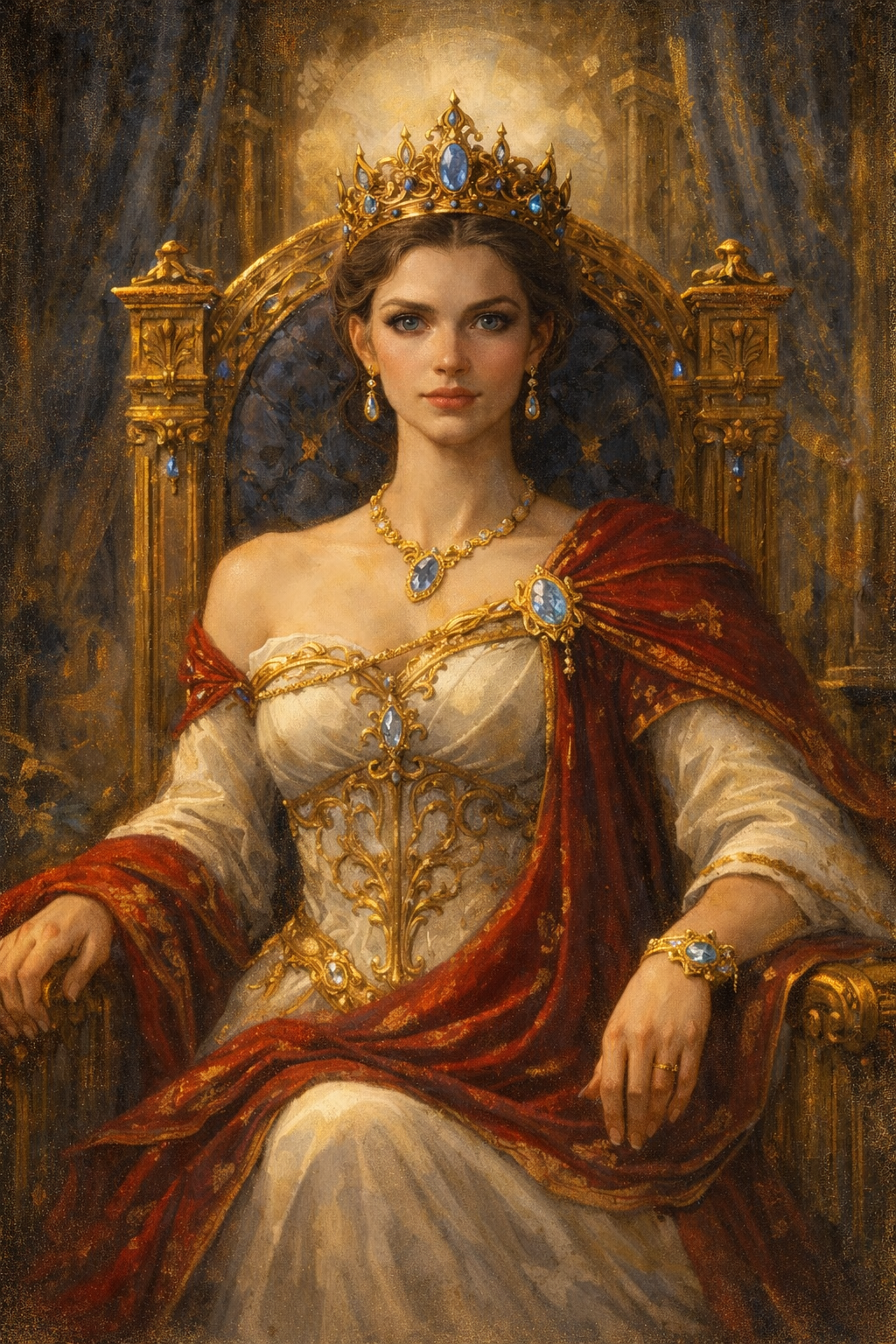 (Portrait of Empress Erolith at the rose palace, art by: Maerwyn Holt, 1503 A.H)
Empress Erolith is a vision of disciplined regality, carrying both the grace of a sovereign and the presence of a commander. She is a young woman of refined features and steady bearing, with warm brown hair most often worn bound back in courtly styles befitting the throne. Her eyes are a clear, piercing blue—calm and observant, yet carrying a weight that unsettles those who stand before her for too long.
In court, she is most often seen adorned in finely tailored imperial gowns of ivory and deep crimson, richly embroidered with gold filigree and set with sapphiric gemstones symbolic of Erule and the Hexadem. Her crown is elegant rather than ostentatious, rising in delicate arcs of gold around a central blue gem that catches the light like frozen flame. Jewels are worn sparingly but deliberately: each necklace, clasp, and ring bearing dynastic, political, or religious meaning.
Her posture is immaculate. Even seated, she appears composed and unyielding, hands resting with controlled ease, her expression poised between mercy and command. There is nothing soft about her presence—only measured beauty sharpened by authority.
Yet Erolith is not a ruler who hides behind silk and marble. When war calls, she does not hesitate to exchange her courtly attire for royal armor. She has been seen riding at the head of imperial hosts, clad in gilded plate marked with the sigils of the Hexadem, her cloak traded for a war mantle and her crown replaced by a battle diadem. To her soldiers, this duality defines her: a scholar-empress upon the throne, and a warborn sovereign upon the field.
To look upon Empress Erolith is to understand that the Erulian Empire is ruled not merely by blood—but by will.
Personality
Section titled “Personality”Empress Erolith is a woman of divided natures, shaped as much by the throne as by the solitude it demands.
In rule, she is authoritative, incisive, and quietly formidable. She governs with a sharp mind and an even sharper instinct, quick to recognize weakness, opportunity, and deceit. Councils often find her already several steps ahead of the discussion, her questions precise, her judgments calculated. She does not rule through spectacle or intimidation alone, but through control—of information, of institutions, and of consequence. Many describe her as cunning, though never careless; every decree is weighed against its ripples across the Empire.
Yet beyond the court and its rituals, Erolith becomes something far more reserved. In private chambers she is contemplative, restrained, and deeply sensitive, burdened by the knowledge that every life under imperial banners is, in some way, hers to safeguard. She carries the Empire not as a possession, but as a responsibility that presses constantly upon her thoughts.
Her devotion to the Hexadem is absolute. Baptised under Tiamat, she structures her life around prayer, study, and ritual. Pleasure, leisure, and indulgence are nearly absent from her days. Where others seek comfort, Erolith seeks meaning. Where others rest, she reflects. She finds little room for hobbies, romance, or celebration, believing that an empress who indulges herself steals time from her people.
Above all, she is deeply attached to the Empire itself—not merely as a state, but as an idea. She longs for its prosperity, its unity, and its spiritual alignment under the Hexadem. Every reform, every campaign, every alliance is filtered through this singular desire: that the Erulian Empire endure, improve, and ascend.
Erolith is capable of great forgiveness when she sees regret, loyalty, or the possibility of redemption. But when faced with betrayal, exploitation, or threats to the Empire or the Hexadem, her mercy vanishes entirely. In such moments she becomes ruthless, not out of cruelty, but conviction. To her, mercy is a gift; stability is a duty.
Those who know her only as Empress fear her.
Those who know her as Erolith understand how much of herself she has already sacrificed.
Resources & Influence
Section titled “Resources & Influence”As Empress of the Erulian Empire, Erolith commands the single greatest concentration of power on Omain. From Erule—jewel of Droskarin and heart of the Empire—her authority radiates across continents, seas, faiths, and economies.
Imperial Territories & Natural Resources
Section titled “Imperial Territories & Natural Resources”The Erulian Empire controls vast and diverse regions of Droskarin as well as multiple overseas holdings and protectorates. Under Erolith’s rule, these lands are not merely governed—they are systematized.
-
Agricultural Provinces:
The lowlands and river-realms surrounding Erule serve as the breadbasket of the Empire. State-managed granaries, irrigation systems, and census-guided crop planning allow the Empire to stockpile food on a continental scale. Grain, fruit, livestock, and alchemical flora are exported or reserved for military and emergency use. -
Mining & Raw Materials:
Imperial territories in the northern and eastern ranges yield iron, copper, rose-tinted alloys, gemstones, salt, sulfur, and rare crystal formations. Several deep imperial mines are dedicated exclusively to state projects: armament forges, temple construction, and experimental academies. These resources fuel both Erule’s armies and its technological and architectural dominance. -
Forests, Stone & Craft Regions:
Controlled forests provide treated timber for fleets, siege engines, and city expansion. Imperial quarries supply white marble, black stone, and enchanted rock used in cathedrals, roads, and fortifications. Entire cities exist solely to refine, craft, and catalog imperial materials.
Economic Power
Section titled “Economic Power”Erolith presides over the most advanced and centralized economy ever recorded.
The Empire operates standardized currency, regulated trade guilds, imperial banks, bonded shipping companies, and state-sanctioned merchant fleets. Trade routes by land and sea are protected by imperial patrols, making Erule the safest and most profitable hub of commerce in Omain.
Colonies, allied states, and protector realms provide steady streams of tribute, rare goods, manpower, and strategic access. Under Erolith’s reforms, taxation was restructured to stabilize inflation, reward innovation, and centralize surplus into imperial reserves.
The imperial treasury funds:
-
massive infrastructure works
-
military expansion
-
research academies
-
religious construction
-
disaster relief
-
and colonial development
Entire foreign markets rise and fall on Erulian policy.
Military Influence
Section titled “Military Influence”Erolith is Supreme Commander of the Imperial War Structure.
Her forces include:
-
The Imperial Legions (professional standing armies)
-
Colonial and provincial hosts
-
Naval armadas guarding both trade and war seas
-
Elementally trained divisions
-
Siege foundries and war-academies
Weaponsmith enclaves, arcane engineers, beast-handlers, and battlefield theologians all operate under imperial charter. Supply chains are so vast that Erule can mobilize campaigns across continents without relying on local provisioning.
Where Erulian banners appear, they do not merely threaten war—they represent certainty.
Political Authority
Section titled “Political Authority”Erolith’s court is the political axis of the known world.
Kings, councils, priesthoods, and city-states maintain embassies in Erule. Imperial envoys serve as negotiators, observers, arbitrators, and quiet power-brokers. Many nations shape policy not around what they desire—but around what Erule will tolerate.
Several realms exist as client kingdoms, trade dependents, or colonial administrations. Their militaries, economies, and succession lines are deeply tied to imperial recognition.
A signature from Erolith can legitimize a crown—or erase it.
Religious & Cultural Influence
Section titled “Religious & Cultural Influence”As a devout ruler baptized under Tiamat and openly bound to the Hexadem, Erolith exerts enormous influence over faith.
Temples, grand cathedrals, pilgrimage routes, relic vaults, and theological academies receive imperial funding. High clergy are confirmed through imperial-religious concord. Major doctrinal movements rarely rise without Erulian acknowledgment.
To many, Erolith is not only Empress—but a living instrument of divine alignment.
Festivals, holy calendars, public rituals, and imperial scripture distribution all originate from Erule. Cultural norms, architecture, legal codes, and even language drift outward from the imperial center.
Knowledge, Administration & Long Reach
Section titled “Knowledge, Administration & Long Reach”The Empire maintains vast census networks, historical archives, bloodline registries, relic catalogues, prophetic records, and cartographic institutes. Scholars, engineers, priests, and strategists are trained under imperial sponsorship.
Knowledge itself is an imperial asset.
Through bureaucracy, record-keeping, standardized law, and regional governors, Erolith’s will reaches even the most distant provincial settlement.
In truth, Erolith’s greatest resource is not gold, armies, or land.
It is structure.
The Erulian Empire under her reign is not merely powerful—it is interwoven into the survival, trade, faith, and future of Omain itself.
Where imperial roads reach, her systems govern.
Where imperial scripture is read, her authority echoes.
Where imperial standards rise, her power is absolute.
Erolith does not rule for glory alone. Every decree she signs, every legion she moves, every temple she funds is part of a long, deliberate vision shaped by faith, fear, and an almost crushing sense of responsibility.
Unification of a Stable World
Section titled “Unification of a Stable World”Erolith’s foremost goal is the continued stability and unification of Omain under Erulian order. She believes that fractured rule inevitably leads to divine imbalance, wars of ignorance, and the rise of forces that mortals are not meant to challenge.
She seeks not merely conquest, but integration—bringing foreign powers into imperial systems of law, trade, faith, and protection. To Erolith, peace is not the absence of war, but the presence of structure.
Preservation of the Hexadem
Section titled “Preservation of the Hexadem”Her devotion to the Hexadem is not ceremonial—it is foundational. Erolith believes the gods act through civilization, and that empires are the vessels through which divine will is stabilized.
One of her deepest goals is to preserve, expand, and doctrinally unify Hexadem worship across all imperial and allied lands. She invests heavily in temples, religious academies, pilgrimages, and the collection of relics and scriptures. She also quietly sponsors expeditions seeking lost sites, forgotten prophets, and pre-imperial divine artifacts.
She fears that doctrinal fracture could weaken the gods’ influence—and invite calamity.
Prevention of Another Erule
Section titled “Prevention of Another Erule”The Siege of Erule defines her reign.
A central, unspoken goal is to ensure that no power is ever again capable of bringing such devastation to the imperial heart. She seeks total military superiority, early-warning networks, arcane defenses, and elemental countermeasures so complete that another assault of that scale would be impossible.
Many of her most aggressive policies stem not from ambition, but from trauma.
Ascension of Imperial Knowledge
Section titled “Ascension of Imperial Knowledge”Erolith believes ignorance is as dangerous as any demon or tyrant. She aims to transform the Empire into the greatest center of knowledge in existence.
She pushes for:
-
imperial universities and research enclaves
-
theological and arcane integration
-
state-funded invention and innovation
-
preservation of ancient records and pre-restoration history
Her long-term ambition is an Empire that can predict famine, prevent rebellion, understand divine phenomena, and outpace every rival civilization intellectually.
Securing the Dynasty
Section titled “Securing the Dynasty”Though she rarely speaks of it, Erolith is acutely aware that empires fall through succession.
She quietly works toward ensuring the permanence of her bloodline and imperial structure, whether through heirs, binding laws, faith-based legitimacy, or arcane and divine protections. She does not seek merely to rule—but to found an age.
Communion with Tiamat
Section titled “Communion with Tiamat”On a more personal level, Erolith seeks direct guidance from Tiamat.
She funds rituals, sponsors high clergy, authorizes forbidden archives, and allows controlled theological experiments in hopes of receiving signs, visions, or revelation. She believes the future of the Empire—and possibly Omain itself—will require more than mortal intellect.
She wants to be ready when the gods finally speak clearly.
A World That Endures
Section titled “A World That Endures”Above all, Erolith’s ultimate goal is simple in concept and impossible in execution:
To leave behind a world that will not collapse.
An Empire that will not fracture.
A faith that will not rot.
A civilization strong enough to outlive her, her line, and perhaps even the age of gods.
The Droplet
Section titled “The Droplet”Empress Erolith I Aquabrand is the current primary descendant of the mortal once branded by Auriel as Aquabrand, bearer of the Soul of the Droplet—the primal embodiment of water, endurance, and unceasing flow. Through this bloodline, the Droplet’s essence has passed from generation to generation, thinning yet persisting, until it now rests within Erolith herself.
The Droplet’s soul dwells inside her, dormant but aware.
Unlike several of her predecessors, Erolith does not “feed” the Droplet—she does not sustain it through excess, ritual consumption, or elemental indulgence. Because of this, the Droplet has not manifested physically through her, nor has she allowed it to reshape her body or fully awaken its ancient power. Where other Aquabrands sought transformation, Erolith has chosen restraint.
Yet the Droplet is not silent.
Erolith is able to speak with the Droplet, not as a voice imposed upon her mind, but as a presence she allows into her thoughts. Their conversations are said to be long, contemplative, and strangely gentle. She seeks its counsel on matters of empire, war, balance, and sometimes on questions that no courtier or cleric could ever answer. In return, the Droplet offers perspective shaped by ages of memory—of rivers before kingdoms, of tides before crowns.
Their relationship is one of mutual respect.
The Droplet is notably pleased with Erolith, for she does not regard it as a weapon.
Her father, Emperor Everet I, wielded the Droplet openly and violently, invoking its power in battle. Most famously, he unleashed it during the Siege of Erule, where water and pressure were shaped into living force to clash directly against King Marek’s Flame. That confrontation scarred the capital and marked the last great manifestation of the Droplet in war.
Erolith remembers this.
She has sworn never to reduce the Droplet to an instrument of destruction unless the empire itself stands upon the brink. To her, the Droplet is not an asset of the throne, but an ancient being bound unwillingly to her blood—one that deserves dialogue before command.
And so it waits within her.
Not hungry.
Not raging.
Listening.
Events
Section titled “Events”Players Must Dig to discover this
Secrets
Section titled “Secrets”Players must dig to discover this