
King Calados I
Overview
Section titled “Overview”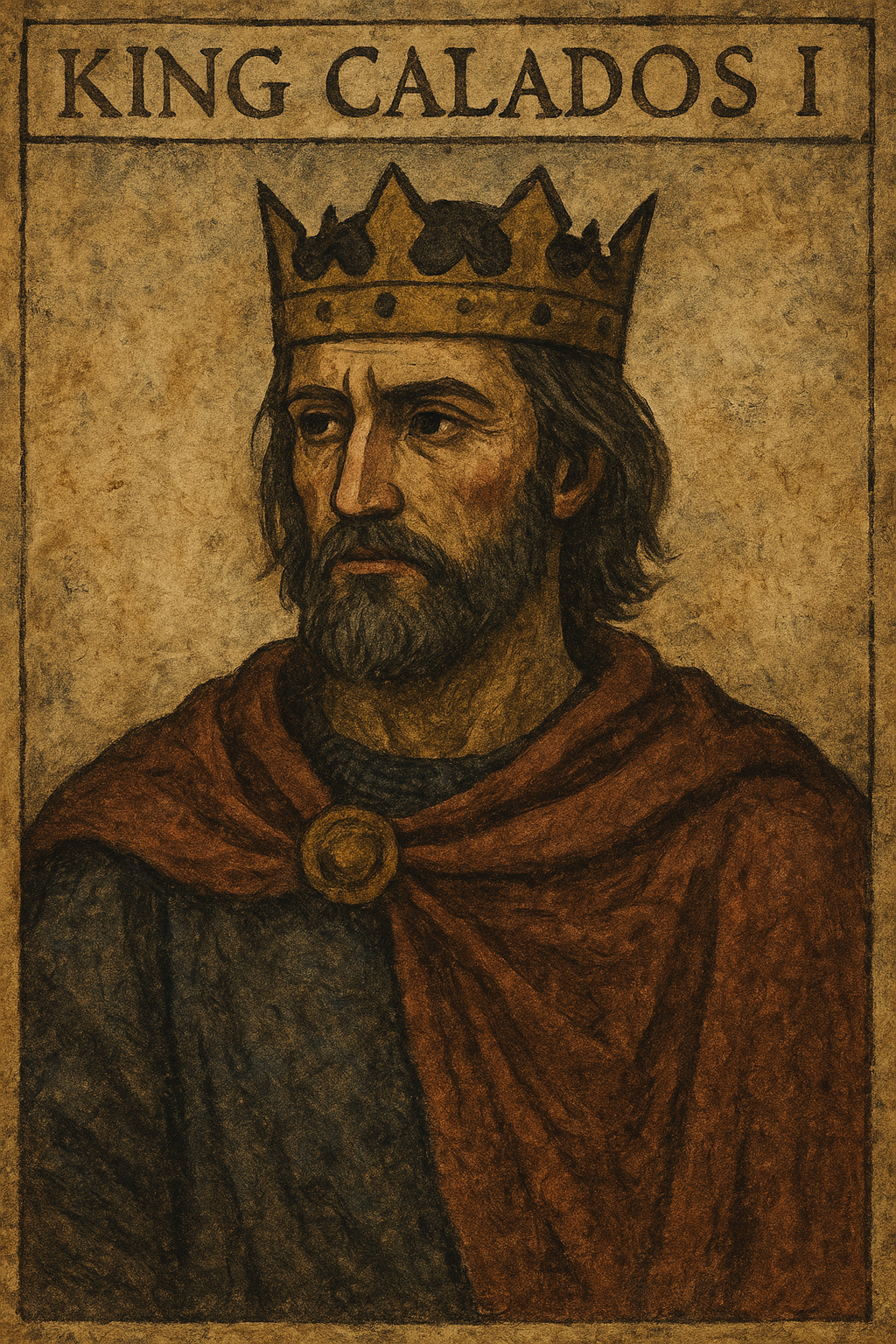 (King Calados I, Art by:Marolen Vestrinar the Elder, 312 A.H)
| Category | Information |
|---|---|
| Full Name | King Calados I |
| Aliases / Titles | The First King, Father of the Empire, Chosen of the Six, Founder of Erule |
| Race / Subrace | Erulian (Human) |
| Gender | Male |
| Date of Birth | –24 B.H. (estimated) |
| Place of Birth | Village of Aureth, Northern Erule, Droskarin |
| Age | 64 at death |
| Status | Deceased |
| Affiliation(s) | Erulian Kingdom → Erulian Empire, Hexadem Faith, House Aquabrand |
| Occupation / Role | First King of Erule, Founder of the Erulian Empire, Unifier of Northern Droskarin |
| Language(s) | Erulian (native), Common |
| Family / Lineage | House Aquabrand (founding dynasty), father of Talios I |
| Religion / Baptism God | Hexadem, Auriel (self-declared spiritual affinity; lived before baptism system existed) |
| Physical Description | Tall, strong build; bronze-tanned skin; dark chestnut hair; pale green eyes; traditionally depicted with a wolf-fur cloak and rose-tinted armor in late life. |
| Personality Traits | Charismatic, visionary, calculated, deeply spiritual, prone to obsession, unusually ambitious for his era. |
| Skills & Abilities | Inspired leadership, diplomacy, early military innovation, deep connection to faith and spirituality; rumored minor elemental attunement to Auriel. |
| Magic Affinity | Weak–moderate elemental sensitivity (wind & light); not a trained spellcaster. |
| Allies | The Seven Prophets, early Hexadem clergy, House Aquabrand supporters |
| Rivals / Enemies | Rival tribal chieftains; skeptical early clans who resisted unification |
| Important Relationships | Spouse: Lady Serella Marinth Heir: Talios I |
| Artifacts / Equipment | The Roseblade (ceremonial sword), Auriel’s Crest (a quartz-tipped scepter), founder’s armor made of rose-hued metal from early Droskarian mines |
| Quotes | “Unity is not given, it is carved.” |
| Legacy | Revered as the founder of the Erulian Empire and the spiritual cornerstone of the Hexadem. His lineage remains unbroken to this day. His reforms shaped the administrative, religious, and cultural identity of Omain’s most dominant power. |
| Year of Death | 40 A.H |
| Cause of Death | Pancreatic failure |
| Burial Site / Memorial | Buried in the Grand Cathedral of the Hexadem, Erule |
| King Calados I Aquabrand is remembered as one of the most influential figures in the history of Omain, revered as the founder of Erule, the father of the Erulian Empire, and the mortal leader who first unified the spiritual and political identity of Humanity. Born into a fragmented era of wandering tribes and inconsistent belief systems, Calados rose to prominence through a rare combination of charisma, spiritual conviction, tactical sense, and cultural foresight. |
Guided by the Seven Prophets and inspired by what he believed to be direct divine influence, Calados oversaw the creation of the Hexadem, now the most widely practiced religion in the world. Under his direction, the seven individual holy writings were sanctified into one sacred tome: The Hexadem, marking the beginning of the Erulian calendar and the dawn of recorded civilization.
In Year 0 A.H., he was chosen by both clergy and populace to become the first crowned ruler of a united nation, establishing the Kingdom of Erule as the first centralized state in Omain. His reign saw the construction of the Rose Palace, the Grand Cathedral, and the foundations of early Erulian governance, architecture, and cultural identity. Calados’s era represented a turning point from tribal existence to the structured world that would dominate Omain’s future.
Despite his achievements, Calados’s later years were marked by a growing obsession with mortality and the darker aspects of the Hexadem, leading to personal instability that contrasted sharply with his earlier vision. Even so, his legacy remains overwhelmingly positive; he is celebrated as the sovereign who turned faith into structure, tribes into a nation, and a continent into a unified cultural force.
Today, Calados is remembered as a visionary monarch, a spiritual pioneer, and the founding pillar of the Aquabrand dynasty, whose bloodline still rules the Erulian Empire centuries later.
Appearance
Section titled “Appearance”King Calados I Aquabrand was renowned for his striking and commanding presence, often described by early chroniclers as “a man carved for rulership.” Standing noticeably taller than the average Erulian of his era, he possessed a broad, athletic build shaped by years of travel, early warfare, and the physically demanding life of the pre-imperial tribes. His posture—straight, poised, and naturally authoritative—helped cement his image as a born leader long before he ever wore a crown.
Calados’s skin tone was a pale bronze, a hallmark of the northern Erulian plains, and he tanned easily under the Droskarian sun. His hair was a deep chestnut brown, thick and wavy, often tied behind the head during his early military campaigns but worn long and unbound during his reign to match the traditional style of early clerics. Portraiture from the era consistently highlights his piercing pale-green eyes, regarded by the faithful as a sign of Auriel’s spiritual favor, and by his contemporaries as the most memorable feature of his expression.
In official depictions, Calados is shown wearing armor forged from rose-tinted Droskarian metal, giving him a radiant, almost divine appearance during ceremonies. The armor’s color—a soft but luminous red—became so associated with his reign that it inspired part of the architectural palette of the Rose Palace. When not armored, he preferred long cloaks of wolf-fur or woven linen, fitting his transition from tribal chieftain to monarch.
Several accounts mention a scar across his left forearm, the result of an early tribal skirmish before the unification of Erule. Calados rarely concealed it, reportedly seeing it as a reminder of the world that came before the Hexadem’s guidance.
Overall, Calados I’s appearance—commanding yet approachable, spiritual yet martial—became the archetype for Erulian royal imagery, shaping centuries of imperial aesthetics and the visual identity of the Aquabrand dynasty.
Personality
Section titled “Personality”King Calados I was defined by a rare blend of charisma, conviction, and visionary ambition, traits that set him apart from the fragmented tribal chieftains of early Droskarin and propelled him into becoming the architect of Omain’s first true nation. His early life shaped him into a resolute and adaptive thinker, capable of navigating both physical hardship and ideological complexity. Even before his coronation, Calados was known for an almost magnetic ability to inspire people to follow him, a quality that later made him the natural unifying figure behind the Hexadem and the foundation of Erule.
Calados possessed a strong, almost unshakeable spiritual sensitivity, which made him unusually receptive to the teachings of the Seven Prophets. To many, he appeared to stand with one foot in the mortal world and another in the realm of the divine—pragmatic in action, but deeply guided by symbolism, prophecy, and sacred meaning. This spiritual conviction was sincere, not performative; Calados believed profoundly in destiny, seeing his rise as part of a larger cosmic design shaped by the gods themselves.
In governance, he was methodical and visionary. Calados valued structure, order, and the pursuit of unified progress. He had a talent for long-term planning and often thought in decades rather than seasons, leading him to make decisions that prioritized stability and the creation of enduring institutions. Yet he balanced his ambition with a notable degree of empathy—early texts consistently portray him as a king who listened to his people, respected the clergy, and strove for moral clarity in times of uncertainty.
However, Calados was not without flaws. His greatest weakness was his tendency toward intense personal obsession, particularly later in life. As he aged, the philosophical questions of mortality, divinity, and fate consumed him. His fascination with the demon Talios—born from the darker tales of the Book of Tiamat—marked the beginning of an introspective decline. Chroniclers describe a shift from his once-clear purpose to an increasingly solitary and brooding demeanor. While this did not undermine his early accomplishments, it introduced a melancholy that shadowed the final years of his reign.
Despite this, Calados remains remembered as a ruler of extraordinary presence: idealistic yet grounded, compassionate yet commanding, driven by a desire to elevate his people and carve a lasting civilization out of the wilderness of early Omain. His personality shaped not only his lifetime, but the centuries of imperial identity that followed him.
Influence & Resources
Section titled “Influence & Resources”King Calados I’s rise from a tribal chieftain’s son to the founder of Omain’s first organized nation was shaped by a wide network of cultural, spiritual, and material influences. His ability to unify early Droskarin was not achieved through strength alone, but through the strategic use of the resources available to him and the guidance of the era’s most influential figures.
Spiritual Influences
Section titled “Spiritual Influences”Calados’s greatest influence came from the Seven Prophets, whose pilgrimages and divine insights shaped his worldview. Their teachings inspired his belief that civilization required structure, faith, and moral order. The Prophets introduced him to the concept of a pantheon with defined purpose, and their accounts of the Massas laid the metaphysical foundation for the Hexadem.
He internalised this doctrine, believing himself chosen to bring divine structure to a fractured world.
Cultural Influences
Section titled “Cultural Influences”Calados grew up among migratory clans of northern Droskarin, witnessing firsthand the instability, tribal rivalries, and constant resource scarcity that plagued pre-imperial humanity. These hardships influenced his determination to create a centralized society, one capable of surviving famine, conflict, and divine whims.
The communal traditions of his people—storytelling, collective leadership, and shared spiritual rites—heavily molded his approach to governance.
Political Influences
Section titled “Political Influences”Surrounded by clan politics and territorial disputes, Calados developed an early understanding of negotiation and compromise. His early alliances with neighboring tribes formed the blueprint for the later unification of Erule.
The need to mediate conflict without constant bloodshed became a key factor in the political systems he established, including the first forms of Erulian councils and clerical advisory bodies.
Material & Geographic Resources
Section titled “Material & Geographic Resources”Calados’s early success was heavily tied to the natural wealth of northern Droskarin. The region provided:
-
Abundant stone and ores, allowing for the construction of early fortifications and, later, the Rose Palace.
-
Fertile plains, which enabled stable food production and the first agricultural surplus in Erulian history.
-
Strategic coastal access, giving Erule its first navy and the ability to expand trade routes.
These resources allowed Calados to build a stable capital and support a growing population—something no tribe had achieved before.
Human Resources & Early Administrative Power
Section titled “Human Resources & Early Administrative Power”Calados was supported by:
-
A loyal clan militia, which formed the core of the first Erulian military.
-
Skilled artisans and builders drawn to Erule as the first organized settlement.
-
The Seven Prophets, who provided spiritual legitimacy unmatched by any rival power.
-
Early scribes and scholars who worked with Eldra Vanton to create the Erulian Calendar, an unprecedented administrative tool.
Religious Resources
Section titled “Religious Resources”The most transformative resource Calados possessed was the budding faith that surrounded him. By uniting the Prophets’ sacred texts into a single work, he created a centralized religious identity.
This spiritual authority allowed him to:
-
Command loyalty without relying solely on military force
-
Justify the unification of tribes under divine purpose
-
Shape Erule into both a political and spiritual capital
The Hexadem became a resource as powerful as any army, allowing Calados to guide his people with a sense of destiny.
King Calados I held a set of ambitious, world-shaping goals that defined both his reign and the future trajectory of Omain. His motivations were a blend of spiritual conviction, political foresight, and personal philosophy, all shaped by the fragmented world he was born into. These goals not only drove his actions but also laid the foundations for the Erulian Empire and the Hexadem’s enduring influence.
Unify the Fractured Tribes of Droskarin
Section titled “Unify the Fractured Tribes of Droskarin”Calados’s earliest and most fundamental goal was to end the cycle of tribal conflict and instability that defined pre-Imperial humanity. Having grown up amid territorial fighting and scarcity, he envisioned a single nation with shared laws, beliefs, and leadership—a world where humanity did not tear itself apart for survival.
Create an Organized, Lasting Civilization
Section titled “Create an Organized, Lasting Civilization”Calados believed that humanity could not advance without structure. His goal was to build the first permanent settlements, establish formal governance, and transition society from wandering clans to a stable kingdom capable of surviving generations. Erule became the first example of this vision realized.
Forge a Unified Spiritual Identity
Section titled “Forge a Unified Spiritual Identity”Guided by the Seven Prophets, Calados sought to unify humanity under a single, coherent spiritual system. His goal was to create a shared religious foundation—the Hexadem—that provided moral guidance, divine legitimacy, and cultural identity for all Erulians.
To him, faith was not merely belief; it was the glue that held civilization together.
Lay the Foundations of Knowledge and Timekeeping
Section titled “Lay the Foundations of Knowledge and Timekeeping”Calados believed that a nation could not flourish without order in time and knowledge. He championed the creation of the Erulian Calendar, the first chronological system in Omain, and supported scholars who formalized early administration, record-keeping, and education.
His goal was to make Erule the intellectual heart of the world.
Strengthen Humanity Against Divine or Mortal Threats
Section titled “Strengthen Humanity Against Divine or Mortal Threats”The stories of the gods, the Massas, and the cataclysms of earlier eras heavily influenced Calados. He believed humanity needed unity and discipline to withstand future divine events or destabilizing forces.
Thus, one of his long-term goals was to build a people with strength, resilience, and spiritual awareness.
Establish a Dynasty that Could Endure
Section titled “Establish a Dynasty that Could Endure”Calados aimed not just to rule, but to ensure the survival of what he built. By anchoring rulership to House Aquabrand and intertwining it with Hexademic doctrine, he created a dynasty that would define the world for millennia.
His vision was a lineage that did not merely hold power, but represented the divine order of the world.
Expand Human Influence Peacefully—When Possible
Section titled “Expand Human Influence Peacefully—When Possible”Although not an expansionist like his descendants, Calados believed that humanity’s survival depended on cooperation, alliances, and eventual growth. His early diplomatic efforts with neighboring tribes show a desire for strategic expansion founded on mutual benefit rather than conquest.
Events
Section titled “Events”Foundational & Positive Achievements
Section titled “Foundational & Positive Achievements”#1. Unification of Northern Droskarin
Section titled “#1. Unification of Northern Droskarin”Calados successfully united several human tribes under a single banner, ending centuries of inter-tribal conflict.
2. Formation of the Kingdom of Erule (0 A.H.)
Section titled “2. Formation of the Kingdom of Erule (0 A.H.)”He became the first crowned ruler of an organized human nation, establishing Erule as humanity’s first structured state.
3. Convocation of the Seven Prophets
Section titled “3. Convocation of the Seven Prophets”Calados brought the Seven Prophets together and supported their work, allowing the Hexadem to take form.
4. Sanctification of the Hexadem
Section titled “4. Sanctification of the Hexadem”Oversaw the compilation and sanctification of the seven holy books into one sacred text: The Hexadem.
5. Establishment of the Erulian Calendar
Section titled “5. Establishment of the Erulian Calendar”With Eldra Vanton’s guidance, he initiated the world’s first formal timekeeping system, marking Year 0 A.H.
6. Construction of the Rose Palace
Section titled “6. Construction of the Rose Palace”Commissioned the Rose Palace, one of Omain’s architectural wonders, made from rare rose-tinted stone.
7. Construction of the Grand Cathedral of the Hexadem
Section titled “7. Construction of the Grand Cathedral of the Hexadem”Built the first major Hexademic religious center, making Erule the spiritual capital of the world.
8. Creation of Organized Governance
Section titled “8. Creation of Organized Governance”Introduced early councils, clerical advisory systems, and the first permanent legal structures in Omain.
9. Founding of Early Military Structure
Section titled “9. Founding of Early Military Structure”Unified clan militias into the first standardized Erulian army, enabling future expansion and defense.
10. Promotion of Early Scholarship
Section titled “10. Promotion of Early Scholarship”Supported scholars, scribes, and clerics, laying the groundwork for Erule as an intellectual center.
Neutral or Complex Events
Section titled “Neutral or Complex Events”11. Integration of Local Tribes Into Erule
Section titled “11. Integration of Local Tribes Into Erule”Used diplomacy, religious legitimacy, and limited force to bring surrounding tribes into Erule’s fold.
12. Codification of Early Laws
Section titled “12. Codification of Early Laws”Calados initiated laws that regulated trade, family structure, and spiritual duties—seen as necessary but strict.
13. Spiritual Reforms
Section titled “13. Spiritual Reforms”Encouraged pilgrimages, rituals, and structured worship, forming the basis of what later became strict Hexademic doctrine.
Controversial or Negative Events
Section titled “Controversial or Negative Events”14. Late-Life Obsession with Death
Section titled “14. Late-Life Obsession with Death”Developed an intense fascination with mortality, afterlife, and the demon Talios described in the Book of Tiamat.
15. Harsh Religious Interpretations
Section titled “15. Harsh Religious Interpretations”Toward the end of his life, Calados pushed stricter moral and spiritual expectations on the clergy and commoners.
16. Increasing Paranoia in Final Years
Section titled “16. Increasing Paranoia in Final Years”Chroniclers note a growing distrust of advisers and an inclination toward spiritual isolation.
17. Strained Relations with Some Tribes
Section titled “17. Strained Relations with Some Tribes”His push for unification caused resentment among clans who resisted Erulian centralization.
18. Overburdening of Labor Forces
Section titled “18. Overburdening of Labor Forces”Late in his reign, construction demands for temples and walls placed heavy strain on workers and resources.
19. Failure to Establish Clear Military Expansion Policy
Section titled “19. Failure to Establish Clear Military Expansion Policy”Though visionary, he left no clear guidelines for future expansion, contributing to the brutality of later reigns.
20. Personal Neglect of Physical Health
Section titled “20. Personal Neglect of Physical Health”Calados’s descent into obsession contributed to his untimely death at 48 from pancreatic failure.
Legacy-Defining Events After His Death
Section titled “Legacy-Defining Events After His Death”21. Elevation as Founding Ancestor
Section titled “21. Elevation as Founding Ancestor”Posthumously revered by the Hexadem and seen as the divine choice of the gods.
22. Establishment of the Aquabrand Bloodline
Section titled “22. Establishment of the Aquabrand Bloodline”Left behind a direct lineage that would rule unbroken for thousands of years.
Secrets/ Fun Facts
Section titled “Secrets/ Fun Facts”1. His Connection to the Prophets Was Not Entirely Divine
Section titled “1. His Connection to the Prophets Was Not Entirely Divine”While official history claims that the Seven Prophets sought Calados through divine guidance, private clerical notes suggest that Calados sought them first, believing himself destined for greatness long before any divine sign occurred.
Some scholars speculate that his “visions” were spiritual intuition—others suspect early magical sensitivity.
2. Calados Experienced Hallucinatory Dreams
Section titled “2. Calados Experienced Hallucinatory Dreams”Near the end of his life, Calados reportedly suffered intense, prophetic nightmares involving the Massas, Talios, and the collapse of humanity.
Priests who attended him claimed he:
-
Spoke in unknown languages
-
Predicted disasters that never came
-
Repeated the phrase: “The sixth shall choose the seventh.”
These visions were intentionally removed from the official Hexadem archives.
3. His Obsession With Talios Began Earlier Than Recorded
Section titled “3. His Obsession With Talios Began Earlier Than Recorded”Chronicles place his fixation on the demon Talios in his later years, but lost correspondence suggests the fear began during the creation of the Hexadem, when reading the Book of Tiamat for the first time.
He concealed this obsession to avoid appearing unstable to the clergy and his people.
4. He Secretly Commissioned a Forbidden Tome
Section titled “4. He Secretly Commissioned a Forbidden Tome”Calados ordered a set of pages—now lost—called The Red Addendum, containing:
-
His personal interpretations of the Massas
-
Warnings about divine intervention
-
Speculation on a “Seventh Era”
The Hexadem denied its existence, implying it was burned after his death.
5. Calados Once Attempted to Contact a Deity Directly
Section titled “5. Calados Once Attempted to Contact a Deity Directly”A ritual performed in secrecy in the late 20s A.H. reportedly involved:
-
Three clerics
-
A quartz focus stone
-
A night spent at the Grand Cathedral’s foundation site
Records suggest the ritual caused Calados to collapse for hours, after which he refused to speak about what he saw.
One of the clerics involved later went missing—presumed dead.
6. His Marriage Was Not Entirely a Political Choice
Section titled “6. His Marriage Was Not Entirely a Political Choice”While publicly framed as a spiritual union, Calados had previously loved a woman from a rival tribe. Her disappearance—never investigated—left a private emotional scar.
Some historians believe the grief influenced his later paranoia and spiritual obsession.
7. His Death May Not Have Been Natural
Section titled “7. His Death May Not Have Been Natural”Though recorded as pancreatic failure, early medical excerpts indicate:
-
Unusual blackening of veins
-
Soft tissue necrosis
-
Symptoms consistent with exposure to forbidden necromantic experimentation
The Hexadem suppressed these notes to preserve his sanctified legacy.
8. Calados Feared His Own Dynasty
Section titled “8. Calados Feared His Own Dynasty”Private letters from his final year show he worried that:
-
His successors might corrupt the Hexadem
-
The empire would fall to tyranny
-
“Blood will undo what blood began”
These fears proved eerily prophetic in later centuries—especially during the reigns of Talios II and Palipes.
9. He Did Not Wish to Be Buried With Honor
Section titled “9. He Did Not Wish to Be Buried With Honor”Contradicting imperial tradition, Calados’s private request asked that he be buried:
“Far from stone and crown, beneath open sky.”
The Hexadem refused, fearing it would undermine the sanctity of the dynasty.
10. He Believed Someone Else Should Have Been King
Section titled “10. He Believed Someone Else Should Have Been King”In his final writings—preserved only in a restricted archive—Calados confessed that he believed:
“Another walked closer to the gods than I.”
He never named who that was.