
Queen Elizabeth I of Thaxted
Overview
Section titled “Overview”| Category | Information |
|---|---|
| Full Name | Queen Elizabeth of House Thaxted |
| Aliases / Titles | The Western Rose, Queen of Thaxted, Lady of the Green Coasts, The Merciful Crown |
| Race / Subrace | Human (Virelyan) |
| Gender | Female |
| Date of Birth | 1469 A.H. |
| Place of Birth | Royal Palace of Westmere, Kingdom of Thaxted, Virelya |
| Age | 38 (as of 1507 A.H.) |
| Status | Alive |
| Affiliation(s) | Kingdom of Thaxted, Western Colonial Council, Hexadem Faith |
| Occupation / Role | Absolute Queen of Thaxted |
| Language(s) | Common (native), Erulian (court & religious), Western Trade Cant |
| Family / Lineage | House Thaxted (western royal line) |
| Religion / Baptism God | Hexadem – Baptised under Eldath |
| Physical Description | Pale complexion; soft but commanding facial features; long light-blonde hair often worn partially bound; calm grey-blue eyes; favors elegant western gowns with subtle royal embroidery rather than heavy regalia. |
| Personality Traits | Empathetic, intelligent, politically cautious, idealistic yet pragmatic, deeply disturbed by injustice, quietly resolute. |
| Skills & Abilities | Statecraft, diplomacy, public oration, conflict mediation, economic reform, cultural unification. |
| Magic Affinity | None known; occasionally advised by Hexadem clerics and court arcanists. |
| Allies | Thaxtian High Court, Hexadem advisers, western trade guilds, select colonial governors. |
| Rivals / Enemies | Anti-royalist factions, extremist cult remnants, foreign interests seeking to destabilize western colonies. |
| Important Relationships | Mother: Queen Victoria of Thaxted (assassinated) • Various colonial delegates • Hexadem clerical councilors |
| Artifacts / Equipment | The Western Signet Crown, Ivory Sceptre of Accord, royal seal of Thaxted. |
| Quotes | “A crown is not worn above the people, but carried for them.” |
| Legacy (ongoing) | Remembered as a stabilizing monarch who transformed Thaxted from a vulnerable western kingdom into a diplomatic and economic pillar of Virelya. |
| Date of Coronation | 18th of Tiarion, 1497 A.H. |
| Cause of Ascension | Assassination of her mother, Queen Victoria, by the serial killer known as Jack the Ripper. |
| Burial Site / Memorial | N/A (living) — Queen Victoria rests in the Royal Sepulcher of Westmere. |
Queen Elizabeth of Thaxted is the current reigning monarch of the Thaxtian Realm and holds absolute authority over all territories, cities, and noble houses sworn to Thaxted. Her reign is widely regarded as merciful, stable, and deeply concerned with the well-being of her people. Among commonfolk she is often called “the Kind Crown,” while within the courts of Omain she is respected as a ruler of restraint, patience, and quiet resolve.
Elizabeth ascended the throne under tragic and violent circumstances. Her mother, Queen Victoria of Thaxted, was assassinated by the infamous serial killer remembered in history as Jack the Ripper. The murder took place on the 12th day of Sharvost, 1497 A.H., within the capital itself. The act shattered the Thaxtian court and plunged the kingdom into mourning, fear, and political instability.
At only twenty-eight years of age, Elizabeth was crowned queen later that same year, inheriting a fractured realm and a throne marked by public terror. Many doubted her ability to rule. Instead, her early reign became defined by open courts, legal reforms, and the steady removal of corrupt influences that had taken root during her mother’s final years. She reorganized the royal guard, expanded internal investigations, and personally oversaw petitions from even the poorest of her citizens.
Now, in the current year of 1507 A.H., at thirty-eight years old, Queen Elizabeth stands as a symbol of recovered hope in Thaxted. Though her reign has been largely peaceful, the memory of her mother’s assassination still lingers over the realm—shaping her caution, her emphasis on internal security, and her quiet but relentless determination that Thaxted will never again be ruled by fear.
Appearance
Section titled “Appearance”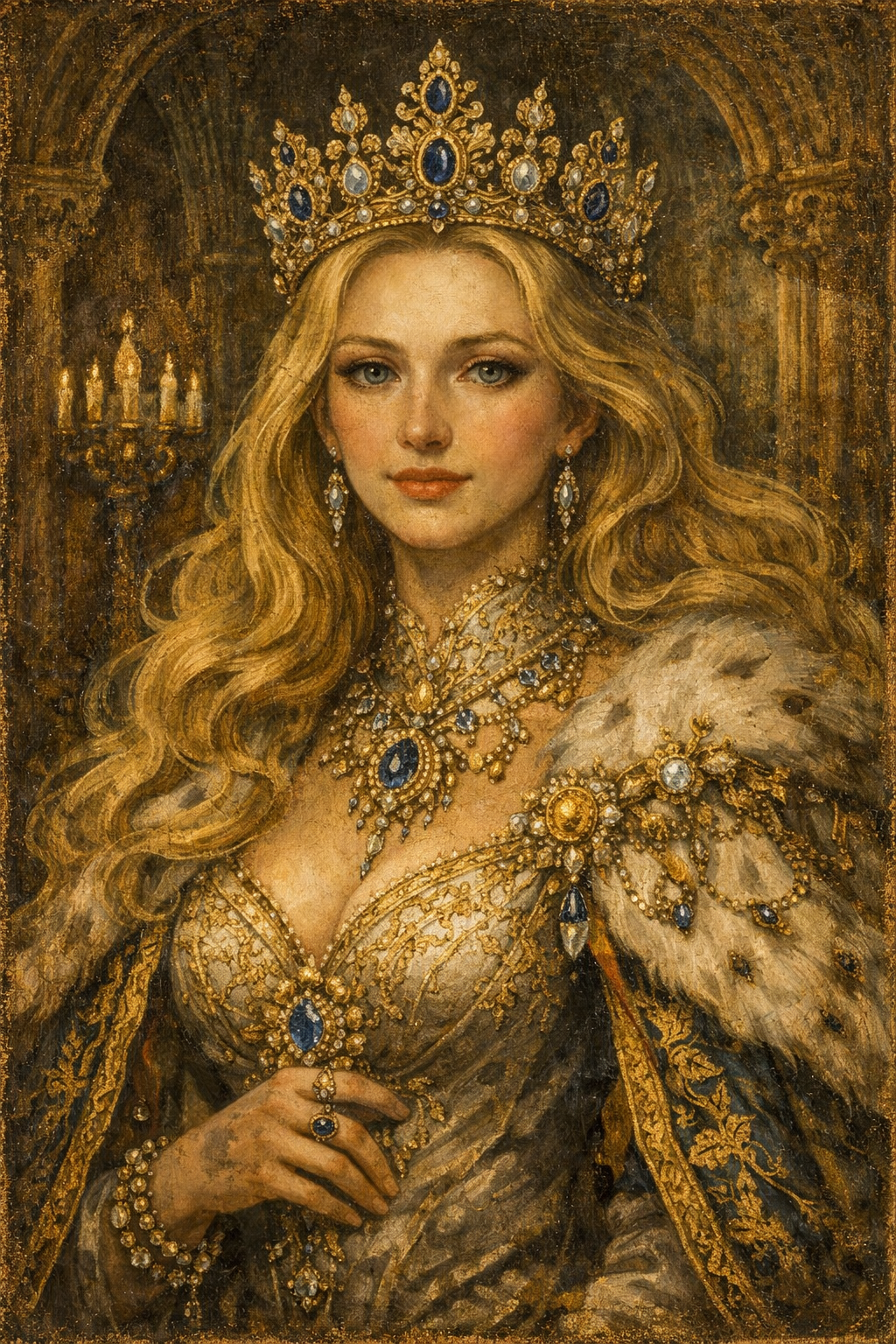 (Portrait of Queen Elizabeth 2 years after crowned queen, art by: Maerwyn Holt, 1499 A.H)
Queen Elizabeth cuts a striking and unmistakably royal figure, one that blends elegance, authority, and an almost ceremonial radiance.
She is tall and poised, with a slender, graceful build that gives her movements a quiet confidence rather than physical dominance. Her skin is fair and carefully kept, her features soft yet symmetrical, giving her a presence that feels warm at first glance—but composed and untouchable the longer one looks.
Her hair falls in long, flowing waves of pale gold, often worn loose over her shoulders like a mantle. In the light of court halls or cathedral windows, it catches and reflects like polished silk. Her eyes are a clear, piercing blue—calm, observant, and rarely unfocused. Courtiers often remark that she seems to look through people rather than merely at them.
She is almost always seen adorned in ceremonial white and royal blue, her gowns richly layered with gold filigree, embroidered patterns, and inset gemstones. Her crown is tall and ornate, wrought in gold and set with deep blue and pale azure jewels that mirror the colours of Thaxted’s banners. It is less a symbol of vanity and more one of office—designed to be seen across vast halls.
In public appearances she bears a regal staff topped with a radiant crystal, an emblem of sovereignty and divine favour. Fine jewelry traces her neck, wrists, and fingers—never excessive, but always deliberate, each piece signifying alliances, victories, or ancestral lineage.
A fur-lined mantle is often worn over her shoulders, symbolising both royal luxury and the responsibility of guardianship. When she stands before her people, Elizabeth appears every inch the monarch: luminous, composed, and untouchably sovereign—yet not cold. There is softness in her expression, a humanity that prevents her beauty from becoming distant or cruel.
Her presence does not command through fear, but through the quiet certainty that she belongs on the throne.
Personality
Section titled “Personality”Queen Elizabeth is widely regarded as a merciful and just ruler, but those closest to the throne understand that her kindness is not softness—it is discipline carefully mastered. She is calm by nature, slow to anger and slower still to speak without thought. In court, she listens far more than she commands. Ministers often find her silent during long debates, only for her to later summarise hours of argument into a few precise sentences that cut directly to the heart of the matter. Elizabeth values clarity, restraint, and foresight, believing that a ruler’s greatest failures are born from impulse.
Despite her regal bearing, she is deeply empathetic. She remembers names, families, and events with unsettling accuracy, and she makes a habit of learning how her laws affect common folk. This has earned her loyalty not through fear or spectacle, but through trust. When she walks among the people of Thaxted, she does so without escorts when possible, speaking plainly and without ceremony.
However, beneath her warmth lies a core of iron. The assassination of her mother ended her youth abruptly, and it left a permanent mark on her outlook. Elizabeth is cautious, almost to the point of paranoia, when it comes to internal security. She rarely shows vulnerability, and only a handful of individuals have ever seen her truly grieve. Betrayal is the one sin she does not forgive easily.
She believes absolutely in the responsibility of the crown. To her, ruling is not privilege, but burden. She sleeps little, works obsessively, and often carries decisions alone rather than risk corrupting them through factional politics. When forced to choose between morality and stability, she seeks a third path—but if none exists, she will choose the realm, and carry the guilt in silence.
Spiritually, Elizabeth is quietly devout. She does not flaunt faith, but prays often, especially before major decisions. She believes the Hexadem guide the world through subtlety, not spectacle, and tries to mirror that belief in her governance.
To allies, she is gracious and thoughtful. To her people, she is a symbol of continuity and healing. To enemies, she is unsettling—because she does not hate them, and she does not rush them. She simply outlasts them. In many ways, Elizabeth rules not as a conqueror, but as a caretaker—one who knows that mercy without strength is meaningless, and strength without mercy is tyranny.
Influence & Resources
Section titled “Influence & Resources”Queen Elizabeth rules the Kingdom of Thaxted, a western realm of Virelya, born from Erulian colonial legacy but long since grown into a sovereign power in its own right. Her authority does not rely on imperial inheritance or divine mandate, but on stability, infrastructure, and the loyalty of a people who have known peace under her crown.
Royal Authority & Governance
Section titled “Royal Authority & Governance”Elizabeth holds complete sovereign rule over the Thaxtian Realm. No foreign power—imperial or colonial—holds legal authority within her borders. All civil law, taxation, provincial leadership, and foreign agreements are enacted in her name. She directly commands:
- All noble appointments and dismissals
- The Royal Court and its ministries
- Legal reform and national policy
- Border administration and internal security Unlike many western rulers, Elizabeth has steadily reduced noble autonomy, shifting power toward a centralized crown and a professional civil administration. This has weakened internal rivalries and strengthened her personal rule.
Military Assets of Virelyan Thaxted
Section titled “Military Assets of Virelyan Thaxted”Thaxted maintains one of the most organized militaries in western Virelya, known as the Gilded Host—a standing, salaried force loyal to the Crown rather than to landholders. Under her rule:
- Permanent royal legions garrisoned in major Virelyan cities Western frontier regiments guarding wildlands and colonial borders
- A professional officer corps trained in Erulian doctrine
- Coastal fleets protecting Virelyan trade routes After her mother’s assassination, Elizabeth restructured the Host so that no single general could command enough power to threaten the throne.
Western Trade & Economic Control
Section titled “Western Trade & Economic Control”Thaxted sits astride some of the most valuable trade corridors of western Virelya. Elizabeth controls:
- River routes feeding the Virelyan interior
- Coastal harbours linking Uxbrid, Garenia, and Shersia
- Fertile colonial plains and managed farmlands
- State granaries, royal treasuries, and mints Thaxted exports food, lumber, crafted goods, and colonial resources, making the kingdom economically indispensable to multiple powers.
Intelligence & State Networks
Section titled “Intelligence & State Networks”Elizabeth commands an extensive internal system of information. This includes:
- Royal couriers operating across Virelya
- Port authorities and customs watchers
- Trade-guild informants
- Quiet agents embedded among frontier towns and noble courts This network was built in response to her mother’s assassination and has since prevented at least three confirmed coup attempts.
Religious & Cultural Standing
Section titled “Religious & Cultural Standing”Though Thaxted lies far from Erule, Elizabeth maintains strong relationships with Hexademical institutions across Virelya. She sponsors:
- Temples and pilgrimage roads
- Theological archives and scriptoria
- Seasonal festivals aligned with the Erulian Calendar While she does not command the Hexadem, she is regarded by much of the western clergy as a “favoured crown.”
Diplomatic Reach Across Virelya
Section titled “Diplomatic Reach Across Virelya”Elizabeth’s court in Thaxted is one of the main diplomatic crossroads of western Omain. She maintains:
- Permanent embassies with Erule and Shersia
- Treaties with Uxbrid, Hatland, and Helskirk
- Colonial trade accords across Virelya
- Neutral-host status for political summits Her approval is often sought before western coalitions or trade wars proceed.
Summary — What Queen Elizabeth Commands
Section titled “Summary — What Queen Elizabeth Commands”- The sovereign crown of Thaxted
- A disciplined western military
- Colonial agriculture and trade arteries
- Royal intelligence systems
- Clerical goodwill in Virelya
- Wide diplomatic recognition Elizabeth’s true power is not spectacle. It is continuity. In a continent shaped by conquest, rebellion, and imperial withdrawal, Thaxted has remained stable for a decade under her rule—and in Virelya, stability is one of the rarest resources of all.
Queen Elizabeth’s ambitions are not driven by conquest or divine obsession, but by preservation, control, and preparation. Having inherited a crown through bloodshed rather than ceremony, her reign has been shaped by the belief that peace is something that must be actively defended.
Secure Thaxted as the Unshakable Power of Western Virelya
Section titled “Secure Thaxted as the Unshakable Power of Western Virelya”Elizabeth’s foremost goal is to make Thaxted politically untouchable. She seeks to:
- Strengthen internal institutions so no assassination, revolt, or noble betrayal could fracture the realm.
- Build a kingdom that can endure even weak successors.
- Ensure that no western coalition, empire, or religious authority can dictate Thaxted’s fate. Her vision is not empire—it is permanence.
Prevent Another Age of Colonial Collapse
Section titled “Prevent Another Age of Colonial Collapse”Elizabeth studies the failures of the Erulian colonial system obsessively. She aims to:
- Create a new western model of governance that avoids rebellion cycles.
- Bind colonies and former imperial territories through economics, not chains.
- Position Thaxted as the stabilising heart of post-imperial Virelya. She believes the west is approaching another great fracture—and intends Thaxted to survive it.
Uncover the Full Truth Behind Her Mother’s Assassination
Section titled “Uncover the Full Truth Behind Her Mother’s Assassination”Though Jack the Ripper was blamed, Elizabeth has never accepted that the murder of Queen Victoria was a lone act. Her long-term private goal is to:
- Identify every noble, cult, foreign agent, or institution that benefited.
- Expose any hidden networks tied to the killing.
- Quietly dismantle them before they can threaten her reign. She does not seek vengeance. She seeks eradication of the cause.
Reduce Dependence on the Hexadem Without Breaking From It
Section titled “Reduce Dependence on the Hexadem Without Breaking From It”Elizabeth reveres the Hexadem, but does not trust any power she cannot govern. She is working to:
- Strengthen secular law alongside divine tradition.
- Limit the political leverage of temples within Thaxted.
- Ensure no prophecy, cleric, or holy decree can override her crown. Her aim is balance—faith without submission.
Prepare Thaxted for the Next Global Conflict
Section titled “Prepare Thaxted for the Next Global Conflict”Elizabeth is convinced another world-shaping war is inevitable. Quiet preparations include:
- Expanding shipyards and reserve forces
- Hoarding strategic resources
- Cultivating western alliances
- Funding exploratory and intelligence expeditions She wants Thaxted positioned not merely to survive a coming storm—but to decide its outcome.
Shape an Heir Who Will Not Repeat History
Section titled “Shape an Heir Who Will Not Repeat History”Whether through future children, chosen successors, or political heirs, Elizabeth’s final goal is to ensure Thaxted never again falls to:
- Complacency
- Noble manipulation
- Religious overreach
- Or blind imperial loyalty She intends to leave behind not a dynasty, but a doctrine of rule.
Summary
Section titled “Summary”Queen Elizabeth does not dream of crowns beyond her own. She dreams of a future where, no matter what gods fall, empires rise, or wars ignite— Thaxted remains standing.
Events
Section titled “Events”Players must dig for this to be revealed.
Secrets
Section titled “Secrets”Players must dig for this to be revealed.